

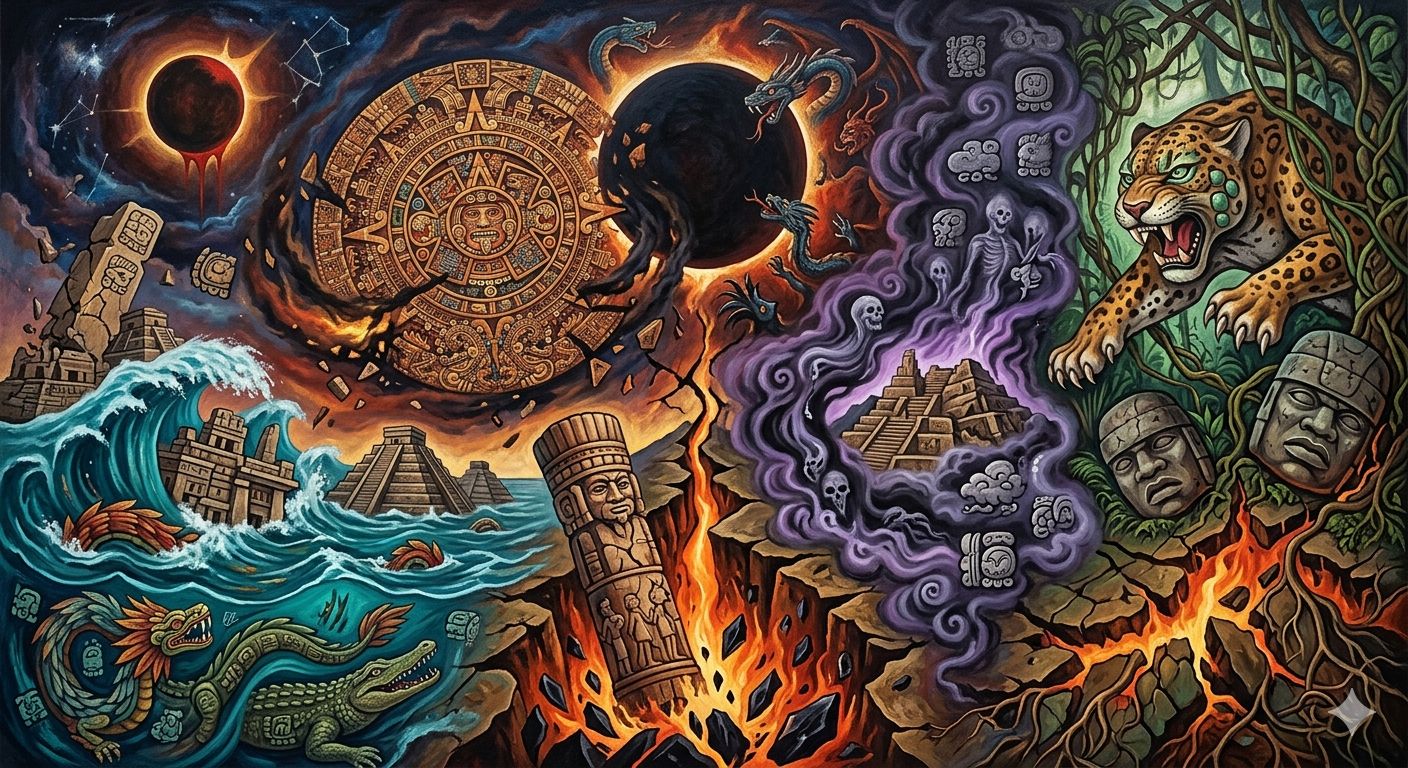
If the birth of the universe in Mesoamerica was a tortuous process of trial and error, then the end of time was never conceived as an eternal salvation, but as an inevitable collapse—violent, purifying, and cyclical.

In pre-Hispanic thought, time showed no mercy: destruction was the only way to cleanse the world’s accumulated decay and allow for a new beginning. For ancient peoples, the apocalypse was not a distant possibility, but a cyclical certainty written in the stars and in the movement of the earth—a constant reminder that everything created is destined to die.
Although they shared a sense of dread toward the final cataclysm, each civilization imagined the end of the world through the elements that shaped their geography and deepest fears. Some envisioned the sky collapsing in a rain of celestial monsters, others feared the universe dissolving into an eternal fog of silence, or the earth itself fracturing under massive earthquakes.
To explore the end of time in these cultures is to peer into a cosmological abyss where the death of the cosmos is the necessary price for the universe to remain alive.
Mexica: The Fifth Sun and the Celestial Monsters (Tzitzimime)
According to the Sun Stone and research from UNAM, the Mexica believed they lived in the fifth era, the Fifth Sun (Nahui Ollin, or “4-Movement”). The previous four ages had already been destroyed by jaguars, hurricane winds, fire rains, and a great flood. The end of our current era is already foretold—and it is the most terrifying of all.
The Mexica apocalypse begins with a global, devastating earthquake that fractures the earth. In this moment of chaos, a total eclipse occurs. As the sun’s light disappears, the skies tear open and the Tzitzimime descend—skeletal deities with jaguar claws, necklaces of human hearts, and skirts made of bones. These astral beings descend upon the earth with a single purpose: to violently and mercilessly devour humanity, extinguishing the world in a form of cosmic cannibalism.
Maya: The Collapse of Xibalbá and the Great Flood

Contrary to the popular myth of the “2012 end of the world” (which only marked the end of a Long Count cycle), the true Maya apocalypse is documented in the Dresden Codex and studied by INAH researchers.
For the Maya, the end of time will come when cosmic order breaks and the waters of the underworld (Xibalbá) rise to flood the surface world.
The final page of the Dresden Codex depicts a terrifying image: a great celestial serpent vomiting torrents of water upon the earth, while the aged goddess of destruction, Chak Chel, pours out a vessel of liquid fury. In this cataclysm, the underworld consumes the earthly realm. Primordial waters erase cities, the jungle is swallowed by the ocean, and time itself comes to a halt—returning the universe to the silence, void, and absolute darkness that existed before the creation of the maize man.
Zapotec: The Silence of Monte Albán

True to their ethereal origin as the Ben’Zaa (“people of the clouds”), the Zapotec of Oaxaca conceived the end of time not as violent destruction, but as a nostalgic dissolution of reality.
Archaeological studies in Mitla (“The City of the Dead”) suggest that the Zapotec apocalypse is tied to the erosion of memory.
For the Zapotec, the world will end when humans stop honoring their ancestors and sever their bond with the sacred mountains. At that moment, the deities of thunder and earth will withdraw their breath of life. A dense, cold, eternal fog—the same from which they were born—will descend from the highlands and cover all the valleys of Oaxaca. Beneath this white veil, human silhouettes will slowly fade, turning back into mist and roots, erasing civilization in an absolute and irreversible sepulchral silence.
Toltec: The Collapse of the Sky

For the Toltec, obsessed with order, stability, and cosmic architecture, the end of the world is a catastrophic structural failure.
In their cosmology, the universe was held in place because Quetzalcóatl and Tezcatlipoca became tree-pillars separating sky and earth. The apocalypse begins when these pillars collapse.
Toltec prophecy warns that human corruption, dynastic wars, and the forgetting of sacred geometry will weaken the roots of these cosmic trees. Once they fracture, the sky itself—along with its immense weight of stars and deities—will fall upon the earth, crushing pyramids, stone cities, and humanity in a single apocalyptic instant. The universe will return to a compact, dark, chaotic mass where space and time cease to exist.
Olmec: The Primordial Earthquake

As the earliest foundational culture of Mesoamerica, the Olmec vision of the end of time is carved into stone altars and subterranean monoliths. For them, the world rests upon the back of a sleeping terrestrial monster: a feline-reptilian deity beneath the earth—the Jaguar God.
The Olmec apocalypse begins when this primordial jaguar awakens in rage. As it shakes off the weight of mountains, it triggers the Great Earthquake of Origins—massive seismic events that fracture tectonic plates and open abyssal cracks, swallowing the Gulf’s rivers and wetlands into the planet’s core. The earth collapses inward, sinking into the dark waters of the underworld’s maternal womb, extinguishing the first age of Mesoamerican civilization.
In Mesoamerican cultures, the end of time was not a rupture in cosmic order, but one of its natural possibilities. Each civilization imagined it from its own landscape, yet all agreed on one truth: the world is not meant to remain intact.
In the constant movement between creation and collapse, the only permanence is transformation.
Discover more from EKTUNKUL
Subscribe to get the latest posts sent to your email.












Leave a Reply