
The origin of the universe in pre-Hispanic Mexico was not a peaceful act of creation, but a cosmic battlefield where gods had to destroy, sacrifice, or repeatedly fail before they could shape reality. For the civilizations of Mesoamerica, time was not a straight line, but an eternal cycle of suns and ages in which the earth demanded the blood of its own creators in order to sustain itself.
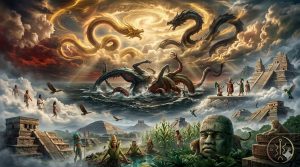
Within this worldview, the birth of the world was understood not as a divine gift, but as a mystical and blood-soaked pact between humanity and the forces of nature, leaving an indelible mark on the historical memory of this territory.
Although they shared the umbilical cord of sacrifice and reverence for the elements, each civilization within what is now Mexico carved out its own genesis according to the geography it inhabited.
From the Mexica, who turned the body of a sea monster into the mountain ranges of the central highlands, to the Zapotec of Oaxaca, who proclaimed themselves children born directly from mountain mist, these cosmogonies shaped the art, architecture, and identity of ancient peoples.
To explore their creation myths is to understand how Mexico’s cultural diversity was born from the very first moment of the universe, when the world had only just begun to be named.
Maya: The Popol Vuh and the Failure of the Wooden Men
According to the chronicles of the Popol Vuh (the sacred book of the K’iche’ Maya), in the beginning there was stillness, silence, and a primordial sea where six deities draped in green and blue feathers rested, among them Tepeu and Gucumatz (the Feathered Serpent). According to research by the National Institute of Anthropology and History (INAH), the process of human creation in Mayan cosmology was an experiment of trial and error by the gods.
The first attempt: They shaped beings out of mud, but they were soft, dissolving in water and lacking awareness.
The second attempt: They created wooden men. Although they could speak and populate the earth, they had no soul, no memory, and forgot to worship their creators. The gods sent a flood of black resin to destroy them; the few survivors fled into the trees and became monkeys.
The sacred material: Success arrived when animals brought white and yellow corn to the gods. With maize—the life-giving element of Mesoamerica—they molded the flesh and blood of the first four true men, endowed with an intelligence that rivaled that of their own creators.
Mexica: The Battle Against the Monster Cipactli
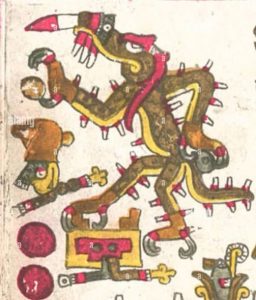
For the Mexica, the origin of the earthly realm required an act of extreme violence against primordial chaos.
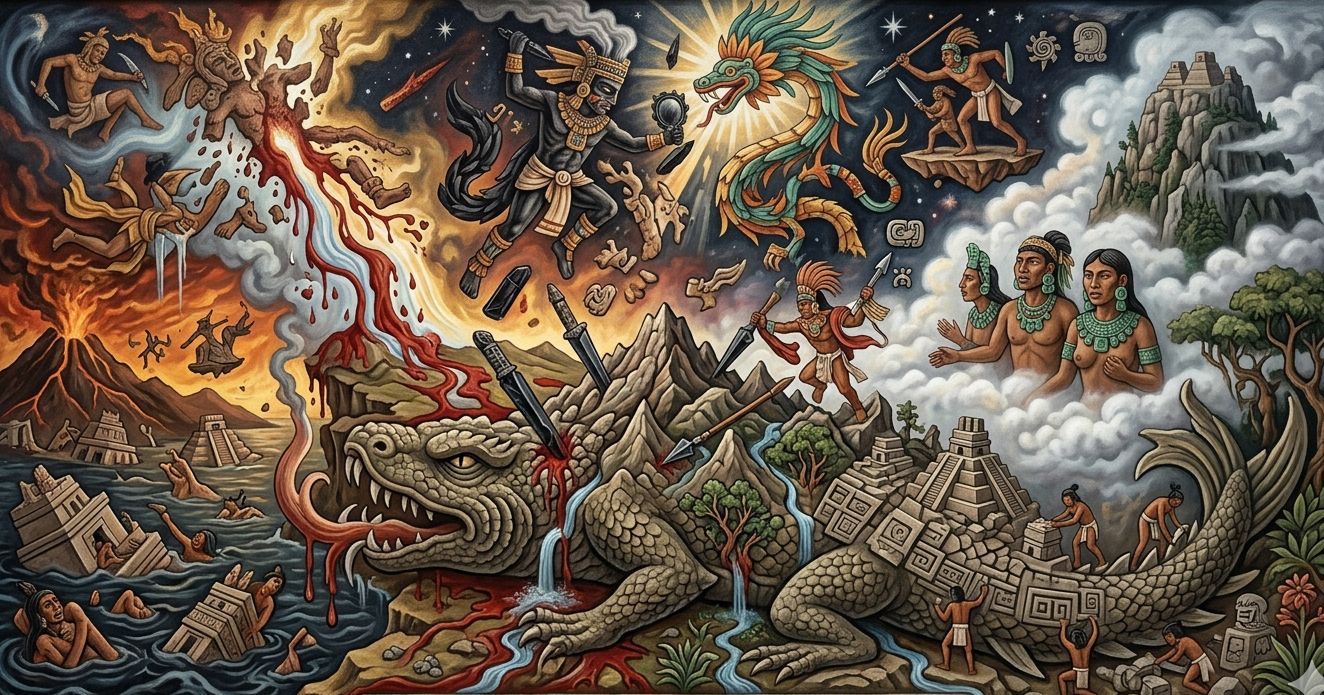
Archaeological interpretations of the Florentine Codex describe that before Earth existed, there was only an infinite ocean inhabited by Cipactli, a colossal and ravenous sea creature, part fish and part crocodile. Its body was covered with eighteen hungry mouths at every joint, devouring everything the gods attempted to create.
Understanding that no order could exist while the beast remained free, the divine brothers Quetzalcóatl and Tezcatlipoca descended from the heavens.
In an act of supreme sacrifice, Tezcatlipoca offered his own foot as bait in the waters to lure the monster. When Cipactli bit down, the two gods threw themselves upon her. After a battle that shook the primordial void, they subdued her and divided her lifeless body in two: the upper half became the heavens, and the lower half became the Earth (Tlalticpac). Cipactli’s mouths became caves, her eyes lakes, and her scales the great mountain ranges of Mexico.
Zapotec: Children Born of the Clouds
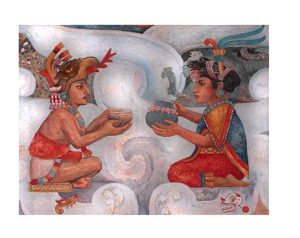
Unlike the empires of central Mexico, the Zapotec culture of Oaxaca possessed one of the most poetic and unique cosmogonies in Mesoamerica. Linguistic studies from UNAM suggest that the Zapotec did not share the belief of being molded from clay or maize by the gods; instead, they considered themselves a natural and divine element in their own right.
In their own language, they called themselves Ben’Zaa or Binnizá, meaning “the people of the clouds.”
Their foundational myth held that their ancestors did not migrate from anywhere, but rather materialized directly on the sacred peaks of Monte Albán from the dense morning mist, the roots of ancient zapote trees, and the souls of jaguars. This direct connection to sky and fog justified the design of their elevated temples, built high in the mountains to remain in permanent contact with their ethereal origin.
Toltecs: The White Serpent
Historical studies place the Toltec culture as the great architect of cosmological thought in the Postclassic period. For the Toltecs, the creation of the world was not chaotic carnage, but an exercise in sacred geometry and cosmic balance.
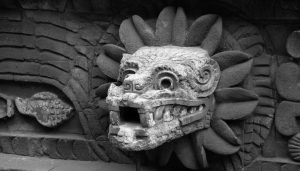
They believed the primordial universe had collapsed upon itself under the weight of the heavens.
The Toltec genesis began when the two supreme cosmic forces, Quetzalcóatl (the White Serpent) and Tezcatlipoca (the Black Serpent), ceased their struggle and transformed into two colossal living trees.
These trees functioned as cosmic pillars that pushed the sky upward, separating it from the earth and creating for the first time the intermediate space where humans could breathe, cultivate, and build perfect cities such as Tula. Their vision of the world’s beginning was governed by architecture and the need to maintain balance between day and night.
Olmecs: The Jaguar God
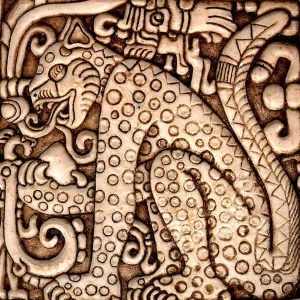
As the “Mother Culture” of Mesoamerica, Olmec cosmology (1200–400 BCE) is the foundation from which the myths of all later civilizations emerged. Lacking direct written records, anthropologists have reconstructed their creation myth through monumental stone and jade sculptures.
For the Olmecs, the universe originated in the depths of the earth’s womb, symbolically represented by the dark, humid caves of the Gulf region. Their genesis tells of a mystical and sacred union between a primordial human woman and the Jaguar God, deity of earth, night, and the underworld.
From this union were born the “jaguar-men,” mythological hybrid beings who possessed the wisdom of the feline and the strength of man, capable of shaping rivers, marshlands, and raising the first artificial mountains (the clay pyramids of La Venta), connecting the earthly world with the forces of the cosmos.
Discover more from EKTUNKUL
Subscribe to get the latest posts sent to your email.











Leave a Reply