
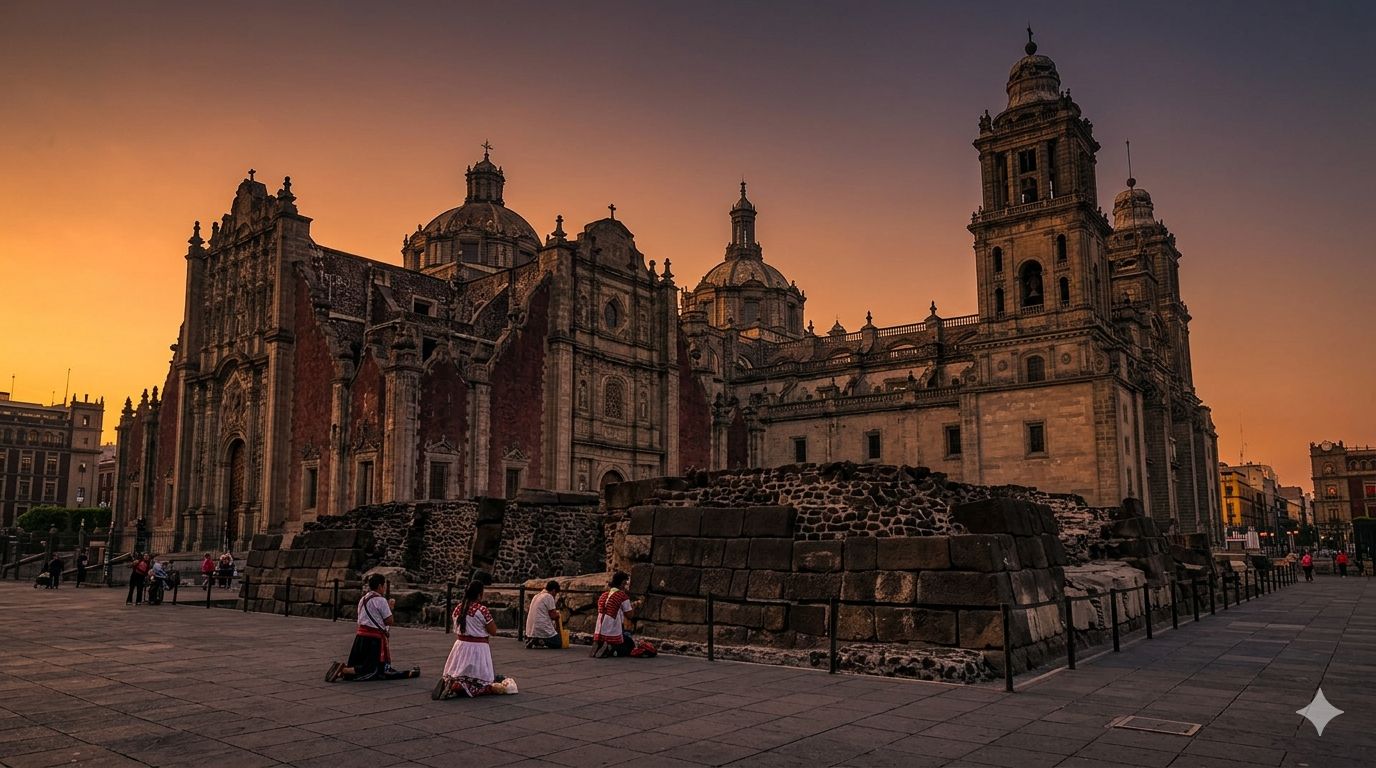
In the stones of the pyramids, in the deer-skin codices and in the memories still preserved in rural communities, there exists a religious substratum that never fully disappeared. Although the conquest shattered the political and ritual organization of the Mesoamerican peoples, Indigenous religion did not die: it bent, disguised itself, hid beneath Christian symbols and survived enigmatically within the very faith that arrived to erase it.
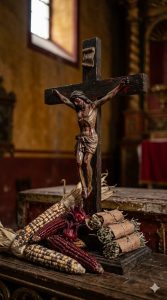
This process — which many scholars describe as religious syncretism — was not simply an exchange of names, but the relocation of divinities, powers and offerings into a framework of images and calendars that appeared new, yet still allowed the same gods to be venerated under different faces.
From the beginning of the colonial presence, the friars understood that if they wished to Christianize Mesoamerica, destroying temples would not be enough: they needed to control the meaning of the sacred itself. The peoples of Central Mexico, Oaxaca, Chiapas and many other regions did not understand the absolute denial of their gods; for them, religion was inseparable from the land, the water, the maize and the blood. As a result, instead of imposing a void, missionaries often transferred the functions of ancient gods onto figures from the Christian tradition, reorganizing the Indigenous pantheon while preserving much of its symbolic core.
Before the Cross
In the Mesoamerican world, gods were not abstract entities: they were personifications of cosmic forces and earthly realities. Among the Mexica, for example, Tláloc — god of rain and fertility — was also linked to underground waters and death as a vital part of the agricultural cycle. Huitzilopochtli, the warrior-sun god of the Mexica people, embodied the perpetual struggle to sustain cosmic order through sacrifice and offerings.
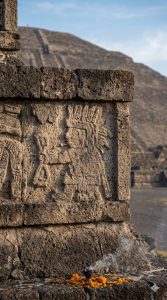
Other pre-Hispanic cultures gave them different names, but many of their deities shared similar functions. Quetzalcóatl, the feathered serpent, appeared as a god of wisdom, wind and knowledge; Centeotl and other maize divinities symbolized abundance and sustenance; while the Earth Goddess — under many local variations — was revered as the mother of both life and death. These gods were not merely “patrons” of war or rain: they were nodes within a system where ritual, calendar, agriculture and politics were deeply intertwined.
This transition became a meticulous translation of cosmological functions in which symbolic “efficacy” mattered most. The Earth Goddess — Tonantzin or Coatlicue — found a natural refuge in the Virgin Mary, who ceased to be solely the mother of Christ and absorbed the role of life-giver and receiver of death. Tláloc, lord of rain, transferred his dominion over the agricultural cycle onto figures such as Saint John the Baptist and other patron saints whose veneration at specific times of the year guaranteed successful harvests. Even Huitzilopochtli and the ancient necessity of blood sacrifice to prevent the death of the sun found a profound echo in the Crucified Christ; for Indigenous communities, the image of the bleeding God was not merely a tragedy of individual redemption, but an act of cosmic reciprocity necessary for life itself to continue, allowing the old sacrificial logic to survive beneath the veil of Christian passion.
The Temple Became a Chapel
One of the clearest mechanisms of syncretism was the physical replacement of sacred spaces. In many regions, friars ordered churches and chapels to be built directly over ancient temples and ceremonial platforms, while statues of Indigenous deities were replaced with images of the Virgin Mary, Christ or Catholic saints. This operation was not merely symbolic: destroying a temple erased a center of power, but building a church upon its foundations preserved the pilgrimage site while redirecting devotion toward the new faith.
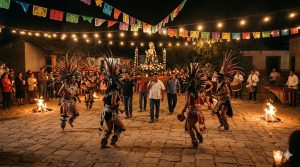
In practice, many communities continued making offerings at these same places, only now before an image of the Virgin or a saint, believing in some cases that the force dwelling there remained the same, merely renamed. The structure of worship changed, but it did not disappear: the repetition of rituals, the offering of flowers, the burning of copal incense and even animal blood in some contexts became integrated into the new liturgy, even when official discourse denied such continuity.
Gods with New Names
Within this process, pre-Hispanic gods were relocated in different ways inside Catholicism. In some cases, their functions were projected onto specific Christian figures. The Earth Goddess, source of life and death, became intertwined with the Virgin Mary, who in the colonial context emerged simultaneously as compassionate mother, intercessor and protector of both land and people. In many regions, women who once prayed to the Earth Goddess now addressed those same prayers to the Virgin, though with gestures, rhythms and symbolic patterns that still echoed ancient traditions.
Other gods, such as Tláloc — deity of rain and water — found ambiguous parallels with saints associated with the land, fertility or rainfall, as well as with ceremonies invoking agricultural abundance, even if official Catholic doctrine never openly acknowledged this continuity. In other regions, the image of the Crucified Christ was reinterpreted by Indigenous communities as a sacrificial figure that silently recalled the ancient logic of blood offerings sustaining cosmic balance.
The Calendar That Adapted
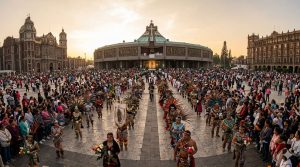
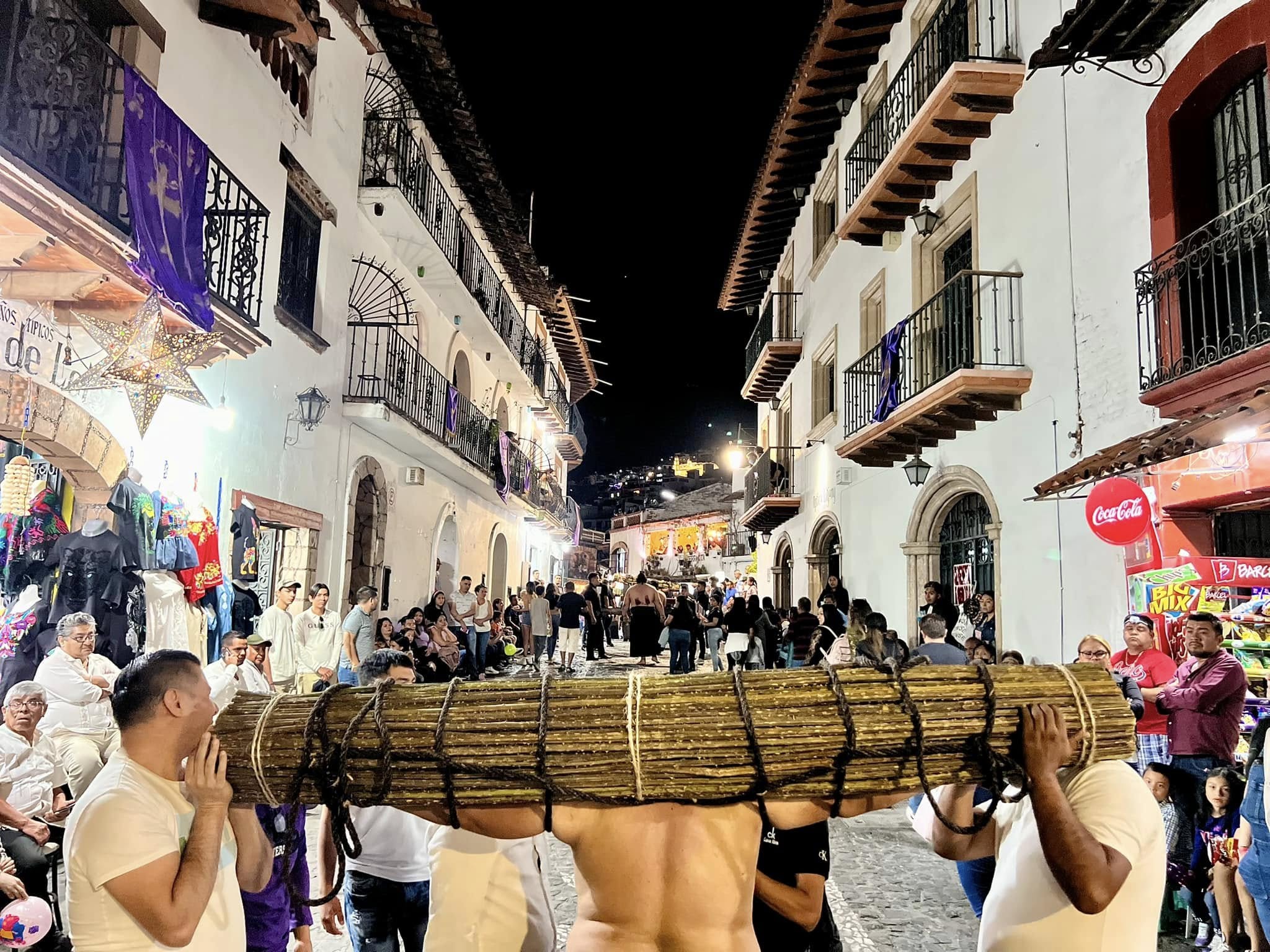
The pre-Hispanic calendar functioned as a ritual map of time: each day was tied to a god, a destiny or a sacred action. Evangelization imposed the Christian liturgical calendar with its saints, feast days and obligations, yet in many communities these new celebrations overlapped with older ritual cycles in such a way that people continued celebrating harvests, rain and death beneath the names of saints and Catholic festivities.
Thus, patron saint festivals often retained the characteristics of ancient agricultural ceremonies in which food was offered, chants were sung and dances were performed whose symbolic content referred to cycles of fertility and renewal already present within pre-Hispanic religion. Official discourse spoke of saints; local practice spoke of an immemorial force manifesting itself at the precise moment when the sun, the earth and the community aligned once more.
The People Who Never Renounced
Although the Inquisition and the ecclesiastical hierarchy attempted to control and purify worship, Indigenous and mestizo communities never entirely abandoned their ancient ways of relating to the sacred. In many villages, Catholicism was practiced ambivalently: people attended Mass, baptized their children and outwardly complied with Christian norms… yet inside homes, fields and nearby hills, rituals continued to be performed that evoked the ancient structures of gods, powers and offerings.
Specialized studies on syncretism in Chiapas and other regions suggest that under intense religious pressure, Indigenous communities constructed a religion of double register: one public, Catholic and visible, and another semi-hidden, where the memory of ancient gods survived even when their original names no longer did. The cross, prayers and images of the Virgin became ritual masks that allowed a fundamentally Mesoamerican spirituality to continue beneath Christian symbolism.
The Deep Silence of Continuity
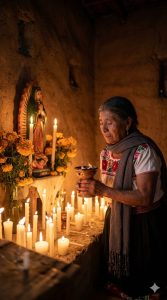
Perhaps the most revealing aspect of this process is that in many regions people do not perceive their religion as a “mixture,” but as a coherent tradition that naturally includes both the Virgin Mary and agricultural rituals, offerings to the earth and ways of speaking about the sacred and the unseen.
For scholars, this suggests that syncretism was not an explicit pact between Indigenous and colonial cultures, but a complex historical process through which Indigenous communities reoccupied the religious space imposed by evangelization, adapting it to their own symbolic logic.
In that sense, the transformation of pre-Hispanic gods was not a simple substitution, but a re-coding: their functions, their relationships with the earth, water and death were relocated within Christian figures without extinguishing the Indigenous matrix beneath them.
What many today call “popular faith” in Mexico is, in many ways, the silent continuity of a sacred world that never fully disappeared.
Descubre más desde EKTUNKUL
Suscríbete y recibe las últimas entradas en tu correo electrónico.






Deja una respuesta