

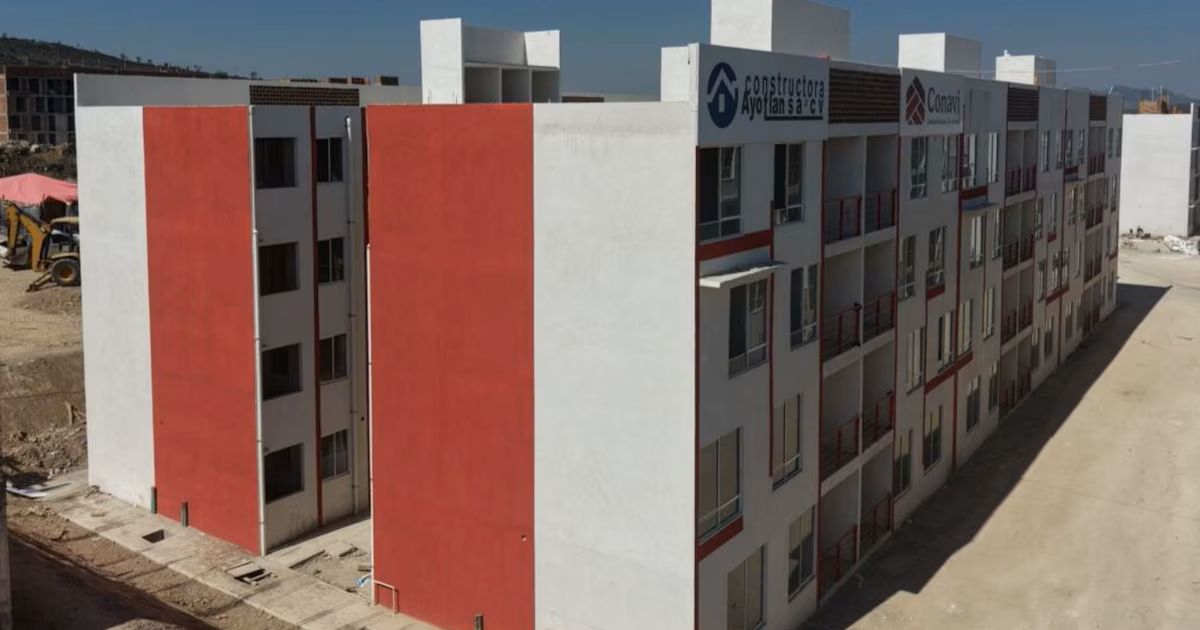
Across many of the states analyzed by Banorte’s Housing Price Indicator (INBAPREVI), the supply is concentrated in newly built homes. Hidalgo, Sonora, Tamaulipas, and San Luis Potosí all report more than 50 percent of their listings in this category. At first glance, this suggests a dynamic construction sector. However, it may also indicate that developers continue launching new projects even as the market’s capacity to absorb them begins to slow.

The Mexican Chamber of the Construction Industry has warned that the sector now faces a very different environment than it did three years ago. The cost of essential building materials—including steel, cement, aluminum, and other inputs—remains well above pre-pandemic levels, even as overall inflation has eased. For developers, this means tighter profit margins and very limited room to reduce home prices.
As a result, builders cannot significantly lower prices because construction remains expensive, while buyers face costly financing and wages that have not kept pace with the cumulative rise in property values. In other words, neither side has much flexibility to change current market conditions.
That may explain why the national monthly increase in asking prices has remained virtually flat at just 0.2 percent.
Sellers continue trying to preserve the value of their properties, while buyers adjust their expectations in a market where purchasing a home depends less on the desire to own one and increasingly on the ability to finance it.
Official Strategy

For years, policymakers assumed that the primary challenge was simply building more homes. New developments continue to appear across the country, but the real issue is whether Mexican families have the financial capacity to transform those houses into homes. That distinction is likely to shape the future of the housing sector for years to come.
Housing prices are also frequently attributed to the effects of nearshoring, reinforcing the official narrative that the relocation of international companies is driving Mexico’s real estate market. While industrial investment certainly influences housing demand in some regions, reducing price increases to this single factor oversimplifies a much more complex reality.
According to Mexico’s Ministry of Economy, the country attracted US$23.59 billion in Foreign Direct Investment during the first quarter of 2026. However, 94.2 percent of that amount consisted of reinvested earnings by companies already operating in Mexico, while genuinely new investments represented only a small fraction of the total. In other words, rather than a massive influx of new businesses, the figures reflect the expansion of companies that were already established.

Although new industrial facilities and logistics centers generate additional housing demand in specific regions, there is little evidence to conclude that rising prices in states such as Hidalgo, Sonora, or Tamaulipas are driven solely by nearshoring. Instead, the market reflects the interaction of investment, urban development, land availability, infrastructure, and the unique conditions of each regional economy.
The contrast between Banorte’s indicator and data published by Mexico’s Federal Mortgage Society (SHF) highlights that diversity. While INBAPREVI reported a four percent annual increase in asking prices during June and a virtually stagnant monthly rise of 0.2 percent, SHF recorded an annual increase of 8.7 percent in the prices of homes actually purchased through mortgage financing during the first quarter of the year. Both indicators are accurate because they measure different stages of the market: one reflects asking prices, while the other records completed transactions.

SHF also provides another important insight into why so many Mexican families feel that homeownership is becoming increasingly unattainable. The strongest price growth occurred in affordable and social housing, where prices increased by 11 percent year over year, compared with 7.5 percent in the middle- and upper-income segments. Ironically, the homes intended for lower-income households are experiencing the greatest inflation.
Financing costs further complicate the picture. According to SHF, based on data from Banco de México, the average mortgage rate during the first quarter of 2026 stood at 11.45 percent. Although the central bank has gradually reduced its benchmark interest rate to 6.5 percent, mortgage loans continue reflecting the accumulated effects of several years of restrictive monetary policy.
The result is a housing market where prices remain high while financing continues to be a significant barrier. Even though monthly price growth has begun to moderate, families see little improvement because the total cost of purchasing a home remains close to historic highs.
Another Way to Read the Numbers
In its latest economic outlook, Banco de México lowered its growth forecast for 2026, citing weaker productive investment, slowing manufacturing activity, and signs of moderation in private consumption. The challenge is that while economic growth loses momentum, the housing market continues operating with elevated prices, limited supply, and construction costs that remain significantly higher than they were five years ago.
The reality is that housing prices remain elevated because supply is still constrained, new housing remains scarce in several market segments, and building costs continue to exceed pre-pandemic levels. The pressure comes from structural factors rather than speculative excess.
A market can slow down while prices remain historically high and, at the same time, become less accessible to millions of families. The key question, therefore, is not whether homes are available, but who can actually afford them. As official data increasingly suggest, the answer depends less on the housing market itself and more on wage growth, borrowing costs, and the ability of Mexico’s economy to generate sustained long-term growth.
Discover more from EKTUNKUL
Subscribe to get the latest posts sent to your email.









Leave a Reply